Bytebase vs. Flyway: a side-by-side comparison for database schema migration

If Flyway is Git, then Bytebase is GitHub/GitLab.
Flyway and Bytebase both handle database schema migration, but they solve different problems. Flyway is a migration engine — you write SQL scripts, run flyway migrate, and it tracks what's been applied. Bytebase is an all-in-one database DevSecOps platform — migration is one part, alongside SQL review, approval workflows, access control, data masking, and audit logging. If your team needs a CLI to slot into existing CI/CD pipelines, Flyway does that well. If you need to control who can change what, enforce review before deployment, and keep an audit trail — that's the problem Bytebase solves.
What They Have in Common
- Native SQL support for defining schema changes.
- GitOps integration — trigger migrations from pull requests.
- Schema synchronization and diff capabilities.
- Change history tracking.
- Tiered pricing with a free community edition.
- Both are open source — Flyway Community is Apache 2.0 (Redgate acquired Flyway in 2019). Bytebase is MIT licensed, with enterprise features under a commercial license.
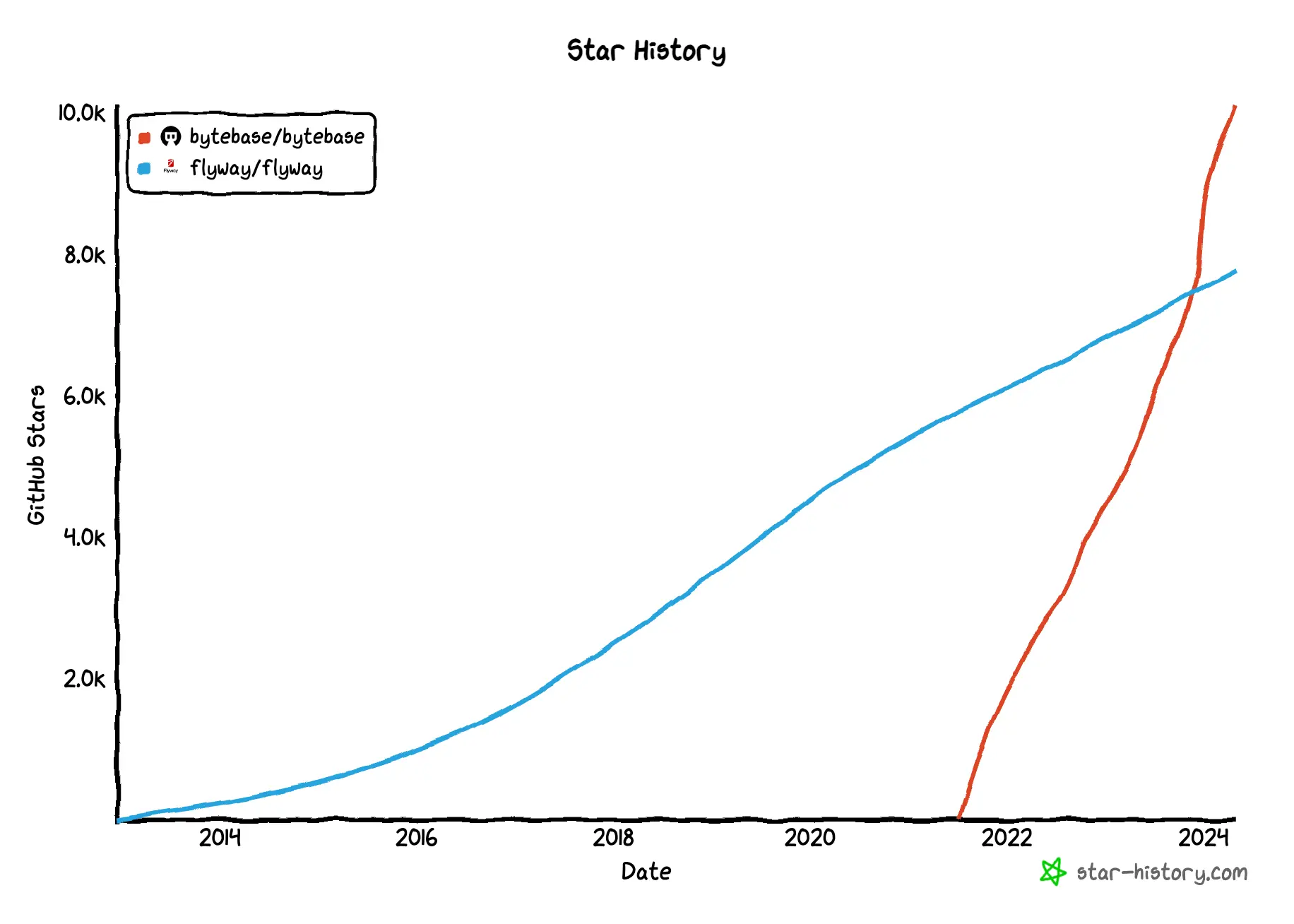
Key Differences Between Bytebase and Flyway
| Flyway | Bytebase | |
|---|---|---|
| Developer interface | CLI + Flyway Desktop (GUI) | Web GUI + API + Terraform provider |
| Supported databases | 30+ | 23 |
| Installation | Java 17 + JVM | Single Go binary, Docker, or K8s |
| Change execution | SQL scripts + CLI | Issue-based GUI or GitOps |
| Schema sync | Flyway Desktop (1-to-1 comparison) | GUI-based batch sync (1-to-many) |
| Batch change | Manual scripting per target | Built-in multi-env / multi-tenant |
| SQL review / code analysis | Enterprise only: 74+ rules (SQLFluff + Redgate rules) | 200+ rules (all tiers) |
| Approval flow | — | All tiers: manual rollout; Enterprise: custom approval |
| Rollback | Enterprise only: manual + auto undo scripts | Auto-generated rollback + sync to any version |
| CI/CD integration | GitHub Actions, GitLab, Jenkins, Azure DevOps, Octopus Deploy, TeamCity | GitOps (GitHub, GitLab, Bitbucket, Azure DevOps) + API |
| Change history | flyway_schema_history table | GUI with diff view + issue linkage |
| Data access control & audit | — | All tiers: workspace/project roles; Pro: SSO, audit log; Enterprise: + dynamic data masking, custom roles, just-in-time data access |
| License | Apache 2.0 | MIT + commercial (Enterprise features) |
Pricing Comparison
| Free | Paid | |
|---|---|---|
| Flyway | Community (Apache 2.0, CLI + Desktop, 30+ DBs) | Enterprise: contact for pricing (AI features, code review policies, state-based deployment, undo scripts, change reports, drift detection) |
| Bytebase | Community (self-hosted, up to 20 users, 10 instances) | Pro: $20/user/mo (cloud-only, up to 10 instances); Enterprise: custom yearly (self-hosted or cloud) |
Developer Interface
Flyway offers two interfaces. The CLI is the primary tool — write SQL migration scripts, run flyway migrate, and it handles versioning and execution. Flyway Desktop (added after the Redgate acquisition) is a GUI application with a schema model view, built-in Git client, and visual diff tools. Desktop supports SQL Server, PostgreSQL, and MySQL.
Bytebase provides a web-based GUI where developers submit changes, DBAs review them, and the platform handles rollout. It also exposes a full API, a Terraform provider for infrastructure-as-code workflows, and GitOps workflow tutorials for Git-driven automation.
Supported Databases
Flyway supports 30+ databases including PostgreSQL, MySQL, Oracle, SQL Server, MariaDB, Snowflake, BigQuery, Redshift, CockroachDB, ClickHouse, MongoDB, DuckDB, and many more. Database support is modular — some engines are community-contributed extensions.
Bytebase supports 23 database engines with deep integration: 9 RDBMS (MySQL, PostgreSQL, Oracle, SQL Server, MariaDB, TiDB, OceanBase, CockroachDB, Spanner), 6 NoSQL (MongoDB, Redis, Cassandra, DocumentDB, DynamoDB, Cosmos DB), 7 data warehouses (Snowflake, BigQuery, Redshift, Hive, ClickHouse, Databricks, StarRocks), and Elasticsearch.
Flyway covers more databases. Bytebase goes deeper on each one it supports — online schema change for MySQL, engine-specific SQL review rules for PostgreSQL, column-level data masking that understands each database's type system.
Installation
Flyway requires Java 17+ (JVM). Install the JVM, then install Flyway. Flyway Desktop is a separate installer for the GUI.
Bytebase ships as a single Go binary with no external dependencies. Deploy via Docker or Kubernetes in under 5 minutes.
Change Execution
Flyway uses versioned SQL migration scripts. Name them V1__create_users.sql, V2__add_email_column.sql, and run flyway migrate. Flyway tracks which versions have been applied in a metadata table and runs only the new ones. You can also use repeatable migrations (prefix R__) for views and stored procedures that get reapplied when their checksum changes.
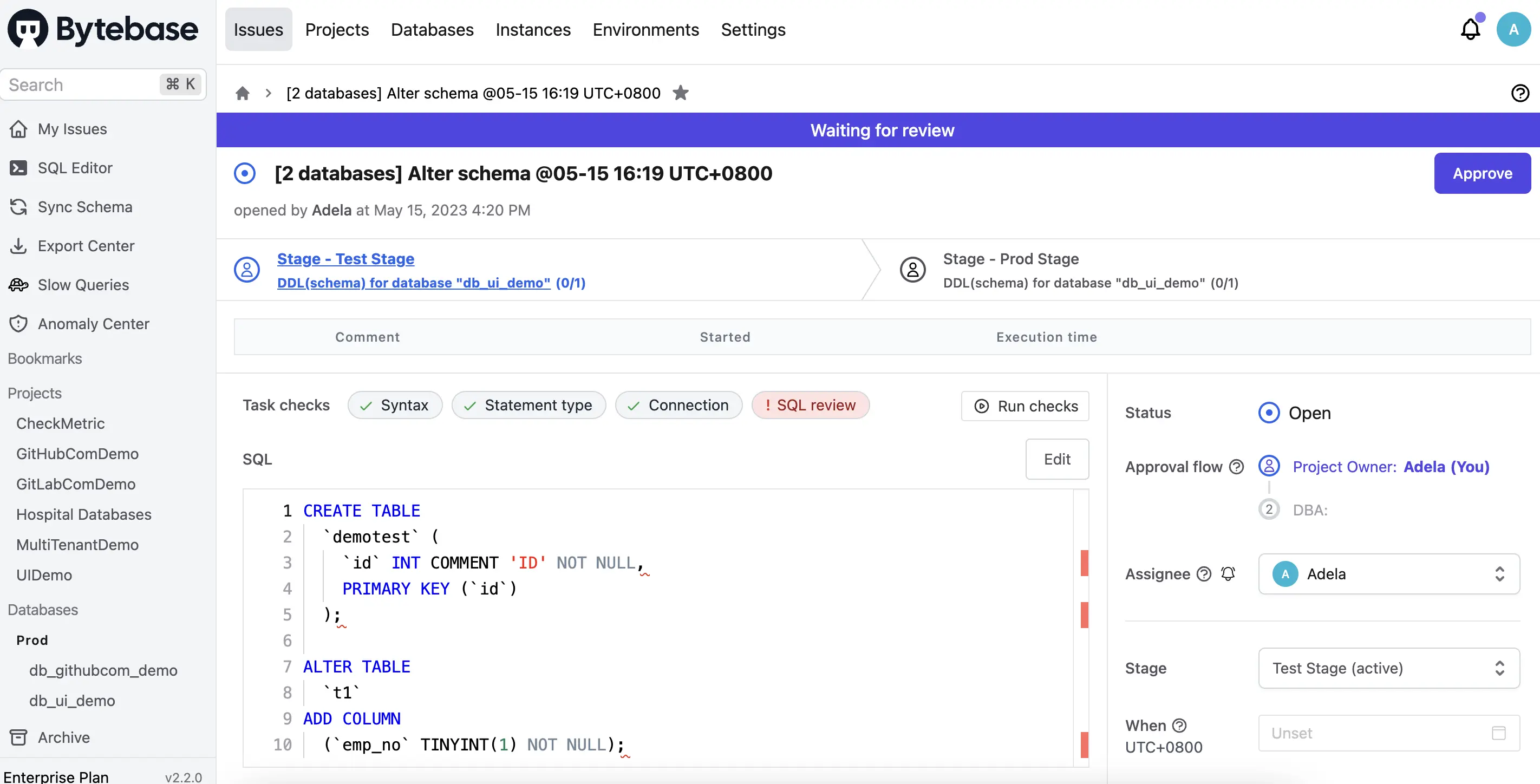
Bytebase uses an issue-based workflow. A developer creates an issue containing SQL statements, which goes through review and approval before execution. Issues can target a single database or batch across environments. Bytebase also supports online schema change for MySQL — large table migrations that would normally lock the table for hours complete in seconds with zero downtime.
Schema Sync
Flyway Desktop provides visual schema comparison between a development database and a schema model. It generates migration scripts from the diff. This is a 1-to-1 comparison — you compare one source against one target.
Bytebase has a built-in schema sync through the GUI. Pick a source database and one or more targets — Bytebase generates the DDL diff for each and applies them as a batch change issue, with SQL review, approval, and audit logging included. Useful for keeping staging in sync with prod, or syncing schema across dozens of tenant databases at once.
Batch Change
Flyway doesn't have built-in multi-environment orchestration. You run flyway migrate against each target database separately in your CI/CD pipeline. You can script this, but it's you writing the orchestration.
Bytebase handles this natively. A single issue can roll out changes across multiple environments (dev → staging → prod) or multiple tenants.
SQL Review and Code Analysis
Flyway Community has no built-in SQL quality checks. Flyway Enterprise includes code analysis with 74+ rules — 60+ SQLFluff rules (open-source linter) plus 14+ Redgate-specific rules for code quality and security. Enterprise also includes a policy library and custom policy integration.
Bytebase includes SQL Review with 200+ rules across MySQL, PostgreSQL, Oracle, SQL Server, and more — available in the free tier. Rules are database-engine-specific, and you can configure error levels per environment (warn in dev, block in prod).
SQL review triggers automatically in two places:
- When a change issue is created.
- In GitOps — when a new PR containing SQL is created.
Approval Flow
Flyway has no built-in approval workflow. Approval happens outside the tool — in your CI/CD pipeline, Jira tickets, or Slack messages.
Bytebase Community and Pro include manual rollout — someone explicitly clicks "Deploy" to apply a change. Bytebase Enterprise adds custom approval flows. You define rules like "DDL on prod needs DBA approval" or "changes touching 3+ databases need manager sign-off," and the system routes each issue to the right reviewers.
Rollback
Flyway Community does not support rollback. Flyway Enterprise adds undo migrations — you write U1__undo_create_users.sql or use auto-generated undo scripts for common operations.
Bytebase auto-generates rollback statements for DML changes and supports reverting to any previous schema version via schema sync. No manual rollback scripts needed.
CI/CD Integration
Flyway fits into any CI/CD pipeline as a CLI step — GitHub Actions, GitLab CI, Jenkins, Azure DevOps, Octopus Deploy, Harness, TeamCity. It's a command-line tool, so it works anywhere you can run a shell command.
Bytebase offers GitOps setup with GitHub, GitLab, Bitbucket, and Azure DevOps. SQL files committed to a repo automatically create change issues in Bytebase, with SQL review running as a merge check. For other platforms, Bytebase's API lets you wire up any CI/CD pipeline.
Change History
Flyway tracks changes in the flyway_schema_history table — a record of which migrations were applied, when, and their checksums. You query it directly with SQL or run flyway info to see a summary.
Bytebase provides a visual change history with schema diffs and links back to the originating issue, reviewer, and approval chain.
Data Access Control and Audit
Flyway doesn't cover this area. It's a migration tool — access control, data masking, and audit logging are outside its scope.
Bytebase layers access control across its tiers:
- Community — workspace and project roles (Owner, DBA, Developer) with built-in permissions, plus SQL Editor for controlled query access.
- Pro — adds SSO, audit log, and user groups.
- Enterprise — custom roles with granular permissions, dynamic data masking at column level, enterprise SSO (OIDC, LDAP), 2FA, and just-in-time data access — developers request temporary query access, a reviewer approves it, and access expires automatically.
When to Choose Flyway
- Your team is CLI-first and wants to embed migrations directly into existing CI/CD pipelines.
- You need to support a wide range of databases (30+), including niche or legacy systems.
- Your developers already work in Java/JVM ecosystems.
- You want Flyway Desktop's visual schema comparison for SQL Server development.
- You need a migration engine, not a governance platform — access control and approval happen in other tools.
When to Choose Bytebase
- You want an all-in-one platform that covers migration, SQL review, access control, data masking, and audit logging.
- Your team includes DBAs or platform engineers who review database changes before they reach production.
- You need compliance — approval flows, audit trails, and data masking for SOC 2, GDPR, or internal security policies.
- You're running multi-environment or multi-tenant deployments where batch change orchestration matters.
FAQ
Is Flyway still open source?
Flyway Community remains Apache 2.0 licensed. Redgate acquired Flyway in 2019 and maintains both the open-source edition and commercial Flyway Enterprise with additional features (AI-powered summaries, auto undo scripts, policy library, state-based deployment).
Can I use Flyway and Bytebase together?
They solve different layers. Flyway handles the migration file format and execution; Bytebase handles collaboration, review, and governance. If you already have a library of Flyway migration scripts, you don't have to throw them away — Bytebase can manage the review and deployment side while Flyway stays as the execution engine.
What is Flyway Desktop?
Flyway Desktop is Redgate's GUI application for database development. It provides a visual schema model, built-in Git client, and schema comparison tools. It currently supports SQL Server, PostgreSQL, and MySQL. It's included in both Community and Enterprise editions.
Which tool has better CI/CD integration?
Depends on what "CI/CD integration" means to you. If it means "I want a command I can add to my Jenkins/GitHub Actions pipeline," Flyway wins — it's a CLI call that works anywhere. If it means "I want SQL files in a repo to automatically become reviewed, approved change issues," Bytebase's GitOps integration does that out of the box.
How does Flyway pricing compare to Bytebase?
Flyway Community is free. Flyway Enterprise requires contacting Redgate for a quote — no public pricing. Bytebase Community is free (up to 20 users), Pro is $20/user/month, and Enterprise is custom pricing. Bytebase pricing details.
Related comparisons: